Sunday, January 24, 2016

Doi Angkhang, Doi Lang, Chiang Saen Lake & Chiang Rai 11 -16 January 2016

Last year we did a trip to the Doi’s and enjoyed birding in the cold weather so this year we arranged another trip coincidentally on the same dates as last year.  A change to the itinerary was to include Chiang Saen Lake which is further north towards Chiang Rai.  We contacted Uthai Cheummarung Chiang Mai Birding  for his availability. 
Rusty-naped Pitta
As it turned out he had recently visited Doi AngKhang and had seen the Rusty-naped Pitta which last year we had a poor view of as it had kept itself partially hidden in the bamboo groves. 
On 11th we flew into Chiangmai and Uthai picked us at 2 pm and drove to Doi AngKhang.  He told us the accommodations at the mountain were tight with the "cold snap" and the flowers in full bloom, many visitors were there photo-taking and enjoying the cold weather.  The only accommodation he managed to book was Ang Garden Resort which is behind the town.  As it turned out, Ang Garden is just next to AngKhang Villa where we stayed last year. Here the room is bigger but similarly basic conditions of the local hotels outside of the AngKhang Nature Resort.


Chinese Blue Flycatcher 

The next day 12th at 6.30 am we left after a quick breakfast and entered the King’s Project and headed to the bamboo garden.  The White-tailed Robin was flying out to check out the morning’s business.  There were 4 WT Robins and they were engaged in territorial fights with each other and disturbed other birds like the Siberian Blue Robin and the Chinese Blue Flycatcher that came to investigate the hide’s offerings.  To our surprise not too long after, the Rusty-naped Pitta appeared and being bigger size, the Robins backed off.   Then another Pitta showed itself to our delight, to see 2 of them together.
An hour later as we were leaving the hide, we saw 3 Thrushes feeding among the bamboo nursery boxes and they turned out to be an Eye-browed Thrush with 2 Grey-sided Thrushes. Uthai was excited as the Grey-sided is considered a rare sighting.  Unfortunately the thrushes were skittish and moved further into the bamboo and did not return.   We left to try the area near the restaurant kitchen for the Black-breasted Thrush.  Indeed a pair was feeding in the garden among the rose bushes. 

Grey-sided Thrush 
We walked around the garden and back to the restaurant platform area overlooking the trees where White-eyes and Bulbuls were feeding among the flowers.  This is one of the best areas for good photos of these fast moving species.  In the afternoon we went to the Thai-Burmese border for the Daurian Redstart which seems to be a regular winter visitor here. 

On Wed 13th  it was another early morning to the mountain roads to check out the pheasants but there was burning of rubbish near the cemetery area and no sign of any pheasant crossing.   We returned to the King’s project to take in the flowers and checked for the thrushes but they did not show at the bamboo groves.   After lunch we left Doi AngKhang for Tatton to check out the Jerdon’s Bushchat at the rice fields.  Someone had seen this rare species but it did not show although we saw a Blue-throat which is also a rare visitor.  Then it was an hour's drive to Fang and we checked into Vieng Kaew’s Resort before going for dinner by the river.
Daurian Redstart
On Thu, 14th it was an early drive at 6.15 am to Doi Lang.  As we reached the mountain road we were surprised we were not the earliest, 3 vehicles were already parked by the road side and photographers were having their breakfast in the early dawn light.  Further along another photographer had put up his hide by the side, they were all at different stages waiting for Mrs Hulme's Pheasant to cross.   Thus we decided to move further to the shrine area and waited for the morning to light up.   During the half hour's wait a few more vehicles passed so we decided to go where they were headed which was the Cutia area.   As we arrived we were lucky to see the White-browed Laughing Thrush and stopped to take some photos.   We then walked up the slope and along a long path to a clearing higher up where at least 10 photographers were sitting comfortably in their foldable stools waiting for the Cutia to come feed at one particular tall tree.
Cutia
   Indeed after 20 mins of waiting, the flock of birds came, it was a quick wave and the Cutias were obscured from view behind the leafy tree.   A second wave came 10 mins later and preceding the Cutias were a small flock of Blue-winged Minlas.   After this second wave it was another long wait but most of the photographers who had taken the Cutia the day before had now their “best or better” shots and left.   We stayed for a while and went down to the main road to look for the Sapphire Flycatcher which had also been sighted but high in the trees.   We did not see it but got good shots of the Siberian Rubythroat, Rufous Gorgeted and White Gorgeted Flycatcher and the Slaty-blue Flycatcher.   Later in the afternoon it was quiet and we walked to the army post where the Chestnut-flanked White-eyes and Mrs Gould Sunbirds were feeding on the pink flowers.


Siberian Rubythroat

White-gorgeted Flycatcher


We left Doi Lang at 1 pm for our 3-hour drive to Chiang Saen and on arrival at the lake Uthai inquired about getting the boat next morning for the trip on the Lake.  It was arranged for 9 am.   We checked into the Serene Hotel next to the river for the night.   On Fri 15th we went earlier to the Lake for a walk around the boardwalk area for other birds.  Two other photographers had also booked the boat for an earlier slot but as there was only one boat it was suggested we go together.   We boarded the boat with one of the lake’s staff and it was enjoyable to be able to see the ducks quite close with the boat stopping now and then for better views.  We saw raptors – Osprey, Eastern Marsh Harrier and Pied Harrier trying to catch their breakfast too.  The Lesser Whistling ducks were making a lot of noise as the boat approached and they took flight.  While the lake is full of Spot-billed ducks we had sightings of the Gadwall, Northern Pintails and Garganey. 
Spot-billed Duck
 

We left Chiang Saen in the afternoon for another 1.5 hour's drive to Chiangrai where we checked into the Nak Nakara Hotel for our final night. On the way we visited the Nam Kham Nature Reserve, a private park but there were not many birds in the hot afternoon. We also checked out a private hospital for the Javan munia that was seen recently but none was found. We bid goodbye to Uthai who will take a 3-hour drive back to Chiangmai. We visited the Chiang Rai Flower Festival (23 Dec 15 to 14 Feb 16) on our way to dinner. It was a relaxing end to our birding trip seeing the beautiful flower and orchid displays.


 Birds Seen:


1)     Ashy Wood Swallow
38)  Japanese White-eye
2)     Black Bulbul39)  Large Niltava
3)     Black-breasted Thrush M & F40)  Lesser Whistling Duck
4)     Black-collared Starling41)  Little Grebe
5)     Blue-throat42)  Long-tailed Shrike
6)     Blue-winged Minla43)  Maroon Oriole F
7)     Bronze Drongo44)  Mountain Bulbul
8)     Brown Shrike45)  Mountain Imperial Pigeon
9)     Brown-breasted Bulbul46)  Mrs Gould Sunbird
10)  Buff-throated Warbler (Lifer)47)  Olive-backed Pipit
11)  Burmese Shrike48)  Oriental Magpie Robin
12)  Chestnut-flanked White-eye49)  Oriental White-eye
13)  Chestnut-tailed Starling50)  Pied Bushchat M & F
14)  Chestnut-vented Nuthatch51)  Pied Harrier
15)  Chinese Blue Flycatcher (Lifer)52)  Plaintive Cuckoo
16)  Cinnamon Bittern53)  Purple Sunbird
17)  Collared Falconet54)  Purple Swamphen
18)  Common Iora55)  Red-faced Liocichla
19)  Common Moorhen56)  Red-whiskered Bulbul
20)  Coppersmith Barbet57)  Rufous Gorgeted Flycatcher (Lifer)
21)  Cutia (Lifer)58)  Rusty-naped Pitta
22)  Dark-backed Sibia59)  Siberian Blue Robin F
23)  Daurian Redstart60)  Siberian Rubythroat
24)  Eastern Marsh Harrier, 61)  Silver-eared Laughing Thrush
25)  Eastern Stonechat62)  Slaty Blue Flycatcher
26)  Eurasian Coot63)  Sooty-headed Bulbul
27)  Eurasian Pochard (Lifer)64)  Spot-billed Duck
28)  Eyebrow Thrush65)  Taiga Flycatcher
29)  Flavescent Bulbul,66)  Western Osprey
30)  Gadwall (Lifer)67)  White Gorgeted Flycatcher
31)  Green Bee-eater68)  White-bellied Redstart M & F
32)  Grey Bushchat M and F69)  White-browed Laughing Thrush
33)  Grey Wagtail70)  White-headed Bulbul
34)  Grey-sided Thrush (Lifer)71)  White-tailed Robin M & F
35)  Hoopoe72)  White-throated King Fisher
36)  Hulme's Leaf Warbler (Lifer)73)  Yellow-cheeked Tit
37)  Indian Peafowl

Monday, December 21, 2015

Kinabalu Park 12 Dec. to 16 Dec. 2015

Bornean Green Magpie
This short 5-day trip was a quick decision that transpired through a couple of e-mails about our friends’ recent trip to Kinabalu Park.

As they had enjoyed their stay at the “Nepenthes Lodge” we said we would join them if they go again.  To our surprise their reply was they can revisit if were interested.  

So it was a revisit after 6 weeks for Lioe and Linda and our first trip to Mt Kinabalu Park.   Linda booked the Nepenthes lodge for 12 to 17 Dec 2015.  This lodge has 2-bedroom units for 4 pax and 2 units were booked for our group of 6 pax.  While we went with Silk Air that arrives in the early afternoon on 12th,  Linda and Lioe came the next evening on Air Asia with Jerry and Valerie.


We had arranged airport transfer with LGM Enterprise (Tel 0138734208) RM250 one-way from Kota Kinabalu Airport to Kinabalu Park HQ rather than take an airport taxi to the city center to get the local minibus (RM20 per pax one-way) up to the Park. It seems taxi’s at the airport would not go all the way to the HQ which was 2.5-3 hours drive depending on the traffic on the mountain road. The late evening transfer would cost RM350 for the group of 4.                                                                                    


Sunda Laughingthrush


On 12th we arrived at the Park and were impressed with the service and accommodation which is managed by Sutera Harbour Resorts.  The rooms were clean and there was daily room service.  The Nepenthes Lodges (10 units) over-look the main road and trees in front of the balcony provided good views of the birds feeding in the morning and evening as they move from the ground up to the canopy. 

At Kinabalu Park the birding route was quite simply the main Power Station road from HQ to Timpohon Gate where the climbers start their ascent.  This 4.5 km road uphill has winding bends at some sections so walking up would be quite tiring.  There were trails along this main road for one to venture but we decided to stick to the road.


Bornean treepie


On 13th we were woken by the sounds of birds at 6 am and as we walked along the road to the HQ which was about 20 mins we saw birds feeding at the various drains and especially the Liwagu River paths.  We had breakfast at the Balsam restaurant and from our tables we can see White-eyes and Yuhinas flying into the trees across the restaurant.  We spent our day birding along the road and also at the Botanical Gardens.   In the late evening, the 4 arrived after a late dinner in town.


On 14th after our breakfast we got a ride from the
Bornean Whistler
Reception to the Timpohon Gate and did our birding walking down.   There are rest stops along the road and bird waves were encountered but the tall trees with dense foliages make it difficult to get clear shots of these birds.  The trails look promising but we did not have time to venture too far.  It took us 3 hours walking down in a leisurely manner.   Lunch was at the Liwagu Restaurant which is the the only outlet at the park with an a’ la carte menu.

The next couple of days were quieter with less bird waves as the sky turned grey each afternoon.   However we were lucky that the afternoon rain, previously predicted, did not materialize during our stay.   We left on 16th morning while the rest enjoyed another day of the cool fresh air of Kinabalu Park.


  Birds Seen:

1
Bornean Whistling Thrush (Lifer)
13
Temminck’s Sunbird (Lifer)
2
Grey Wagtail
14
Grey-chinned Minivet
3
Sunda Laughingthrush (Lifer)
15
Yellow-breasted Warbler (Lifer)
4
Indigo Flycatcher
16
White-throated Fantail
5
Little Pied Flycatcher
17
Bornean Green Magpie (Lifer)
6
Bornean Treepie (Lifer)
18
Velvet-fronted Nuthatch
7
Chestnut-hooded Laughing Thrush (Lifer)
19
Pale-faced Bulbul (Lifer)
8
Chestnut-crested Yuhina (Lifer)
20
Mountain Leaf Warbler
9
Erponis
21
Black-capped White-eye (Lifer)
10
Mugimaki Flycatcher
22
Black-sided Flowerpecker (Lifer)
11
Ferruginous Flycatcher
23
Blue-and-white Flycatcher
12
Bornean Whistler (Lifer)


Hong Kong 1 Nov. to 4 Nov. 2015

Azure-winged Magpie
It was a special fare of S$249 return to HK that got us planning another trip to HK.  Although we were restricted to take an afternoon flight arriving almost 7 pm in HK we were keen to revisit the sites that we had been earlier in the year.  We were able to catch the local bus E34A from the airport which took 1.5 hours to our hotel in the New Territories.  Compared to a taxi ride (HK$380) the fare of HK$13.90 per person on the bus was worth taking for a 30 mins longer ride.  This bus terminates next to the Harbour Plaza Hotel less than 5 mins walk away. 
On Sunday 1st Nov after a good night's sleep, we took a taxi to Maipo village.   We walked along Tam Kon Chau Road and checked out the birds feeding in the canal and nearby abandoned fields.  There were sandpipers, egrets, commorants and on the trees bulbuls and Japanese white-eyes feeding on the fruits. The Azure-winged Magpies were easily seen as we approached Maipo Reserve.   At the visitor center we met a local birder who showed us his photographs of the Forked-tailed Sunbird.  This trip we did not apply for the permit to enter the reserve so we birded outside the area.  When it was time to leave for lunch the WWF staff was kind enough to call a taxi for us.   We asked to be taken to Sheung Shui MTR station as we knew there would be a minibus 51K that will bring us Long Valley for our afternoon birding.
Great Cormorant

We had lunch at Sheung Shui and arrived Hor Siong Heung after 2 pm.   We had bean curd for dessert at the Bean curd shop where visitors in bus loads come for their their sweet treat.  We walked to the farms, and the birds were similar to the ones we had seen in our previous trip with few migratory species yet.  The Black-winged Stilts, Plovers and Egrets, were feeding in the flooded fields, while some swallows were flying around.  Some photographers were taking shots of these Red-rumped Swallows.  We left at 4 pm, took the bus 51K back to Sheung Shui, and a taxi ride back to the hotel.
On Monday 2nd November we decided to take the local bus 276B to Sheung Shui then minibus 51K to Hor Sheung Heung.  We arrived 9.15 am, our second try for morning birds at Long Valley. It was the same few birds we saw yesterday and we left at 11 am.
Yellow-cheeked Tit
In the afternoon we went shopping at Mongkok.
On Tuesday 3rd Nov we met with Chun Fei at Shatin MRT and he suggested taking bus 28K to Tai Po Kau.  We walked up and along the way met Mike who asked if he can tag along since he was visiting Tai Po Kau for the first time.  As we walked past the rest area and up the slope, a bird wave greeted us.   Yellow-cheeked Tits and Grey-chinned Minivets were out feeding on the trees.  After this bird wave we came to a quiet picnic area where tables and benches were set out.  In the tall trees the Rhesus Macaques were playing and making a lot of noise.  We walked down at 11.30 am leaving Mike to continue exploring other trails.  We went back to the hotel to put away our camera and bins and took off for Mongkok again.   This time we found some outdoor clothes shops at Nam Cheong Street.  At Heng Chung Hang we bought some long-sleeve shirts, rain jacket and pants.
Erpornis

Wednesday 4th November morning we walked around Tin Sui Wai Park to test out the new 300mm Nikon lens.  Then it was a short trip to Yuen Long for some “wife cakes” from Hung Heung.  In the afternoon we took the Light Rail to HK Wetlands Park and did some birding along the boardwalks.  
Thursday 5th Nov early morning we checked out and took the hotel airport bus HK$60 per pax to the airport, it was an hour’s ride in the morning light traffic.


  Birds Seen:

1
Black-collared Starling
23
Chinese Bulbul
2
Chinese Pond Heron
24
Japanese White-eye
3
Little Grebe
25
Common Moorhen
4
Little Egret
26
Oriental Magpie Robin
5
Great Egret
27
Spotted Dove
6
Grey Heron
28
Eurasian Tree Sparrow
7
Masked Laughing Thrush
29
Yellow-cheeked Tit
8
Common Kingfisher
30
Black-winged Stilt
9
Siberian Stonechat
31
Scaly-breasted Munia
10
Grey Wagtail
32
White-rumped Munia
11
White Wagtail
33
Red-rumped Swallow
12
Plain Prinia
34
Grey-chinned Minivet
13
Great Comorant
35
Eurasian Magpie
14
Crested Myna
36
White-throated Kingfisher
15
Oriental Reed Warbler
37
Blue and White Flycatcher
16
Common Sandpiper
39
Fork-tailed Sunbird
17
Wood Sandpiper
40
Dark-sided Flycatcher
18
Little-ringed Plover
41
Dusky Warbler
19
Long-tailed Shrike
42
Mountain Bulbul
20
Azure-winged Magpie
43
Velvet-fronted Nuthatch
21
White-cheeked Starling
44
Erpornis
22
Red-billed Starling
45
Daurian Redstart
23
Red-whiskered Bulbul


Sunday, December 6, 2015

Laem Pak Bia, Pak Thale & Kaeng Krachan 22 - 27 November 2015

Laem Pak Bia wetlands and Pak Thale salt pans in Petchaburi are 2 sites well-known for waders and shorebirds and during Thailand’s dry “winter” months October to March when the birds migrate
Entrance road to Pak Thale
from the northern winter the critically endangered Spoon-billed Sandpiper has been reported to be seen at Pak Thale.  Both sites are within 3 hours’ drive from Bangkok airport and we included them on this trip to Kaeng Krachan.  We booked the i Tara Resort & Spa, a seaside resort on the northern sandy beach of Petchaburi for 2 nights.  Nearby were some salt pans but generally the area is a village with a few shops and a couple of small establishments for dinning out, a peaceful place to stay for sun and sea without the crowds.


Black-winged Kite

On Sunday 22, Uthai from Chiangmaibirding picked our group of 4 from Don Meung airport. The Air Asia flight arrived at noon and after a quick stop at one of the highway cafes, we arrived Laem Pak Bia at 3.30pm.  We saw 2 Black-winged Kites and many Red-turtle doves on the wires along the country roads.
After checking into the i Tara Resort, we went to Pak Thale salt pans for a quick look before the sunset. 

Caspian Tern
The waders were feeding in flocks but quite far out and we spotted another vehicle near a shed. It was not easy trying to scope the "Spoonie" among the waders.  We saw lots of Plovers, Gulls, Sandpipers and Terns.  The driver of the vehicle passed us on his way out and mentioned he had seen 1 Spoonbill Sandpiper among the flocks.  We scrutinised the flocks with the scope but the sunlight was waning so we decided to leave and return the next morning for a longer stay. On Monday 23, after breakfast, we left at 7.30 am to the Laem Pak Bia King’s Project near us and drove along the bunds of the ponds. There were mainly Javan Pond herons, Black-winged Stilts and Egrets feeding with Little Commorants perched on sticks and structures in the ponds. 


Common Tern 
We took a short walk on the mangrove boardwalk and a couple of Pied Fantails and Yellow-bellied Gerygones were singing but hard to see in the thick foliage.  We then drove to Pak Thale and stayed till lunch time.  We moved quite close to the sea but each time we come close, the flocks would fly to another spot.  It was difficult spotting the tiny Spoon-billed Sandpiper.  We left at noon to escape the hot sun. There was time to kill after lunch so it was a relaxing spa treatment at the i Tara.  At 4pm we went back to Pak Thale but could not locate the star bird.

On Tuesday 24 we went to Laem Pak Bia King’s Project and this time we walked the full boardwalk
to the sea end and it was a spectacular view of the mangrove forest as we looked back.  As we had booked a visit to Lung Sin's hide at Kaeng Krachan in the afternoon, we left Laem Pak Bia around 10.30 am for the 2-hour drive.
We checked into Baan Song Nok around noon and had lunch at a nearby "restaurant" watching an Indian Roller who was hiding from the hot sun. 

On Wed 25, we left at 6 am to Paneongtung summit  which was 1.5 hours drive from the Park entrance.  
Chestnut-headed Bee-eater
Many visitors had camped overnight at the top to catch the sunrise over the white fluffy clouds.  There was a fruiting tree across the valley near the campsite and barbets, bulbuls and flycatchers were busy feeding in the early morning.   After our breakfast we drove up to another viewpoint looking for the dried bamboo flowers that the Pin-tailed Parrotbills feed on.   At 10 am a bird wave brought the parrot-bills but it was difficult to photograph these small birds so we waited for another round of feeding.  Near lunch time we drove down to Bang Krang campsite, while walking around the campsite we saw a pair of Violet Cuckoos feeding in the trees. On the way down we stopped by a couple of fig trees with birds feeding but the foliage was thick and hard to photograph the birds.   We went back to Ban Song Nok and birded at the hide till dinner time.


Thursday 26 we left at 6.30 am for the Park and stopped on the road near the big fig tree at km 8 to stake out the Black-thighed Falconets that had been regularly seen. It was still misty when 3 Falconets came but they flew off too quickly.  We waited for their return but they did not show after
Green Magpie
an hour or so, meanwhile we heard the knocking of wood and found a Heart-spotted Woodpecker building a nest hole.  She was then relieved by the male after some time.  The male extracted the chippings from the hole and continued with his pecking work.   We spent some time watching this pair then drove on to Bang Krang for lunch.  We left after a short stay and drove out of the Park to the coffee place opposite Sarman's Bird Camp and while having coffee we had good views of the Thick-billed Flowerpeckers feeding on the Indian Cherry trees.  Towards the late afternoon it was back to Auntie Aek's hide and it was the usual suspects that came to bathe at the 2 pools.


We left Friday 27 after breakfast and it was a longer drive back to Don Meung due to heavy traffic


Black-naped Monarch
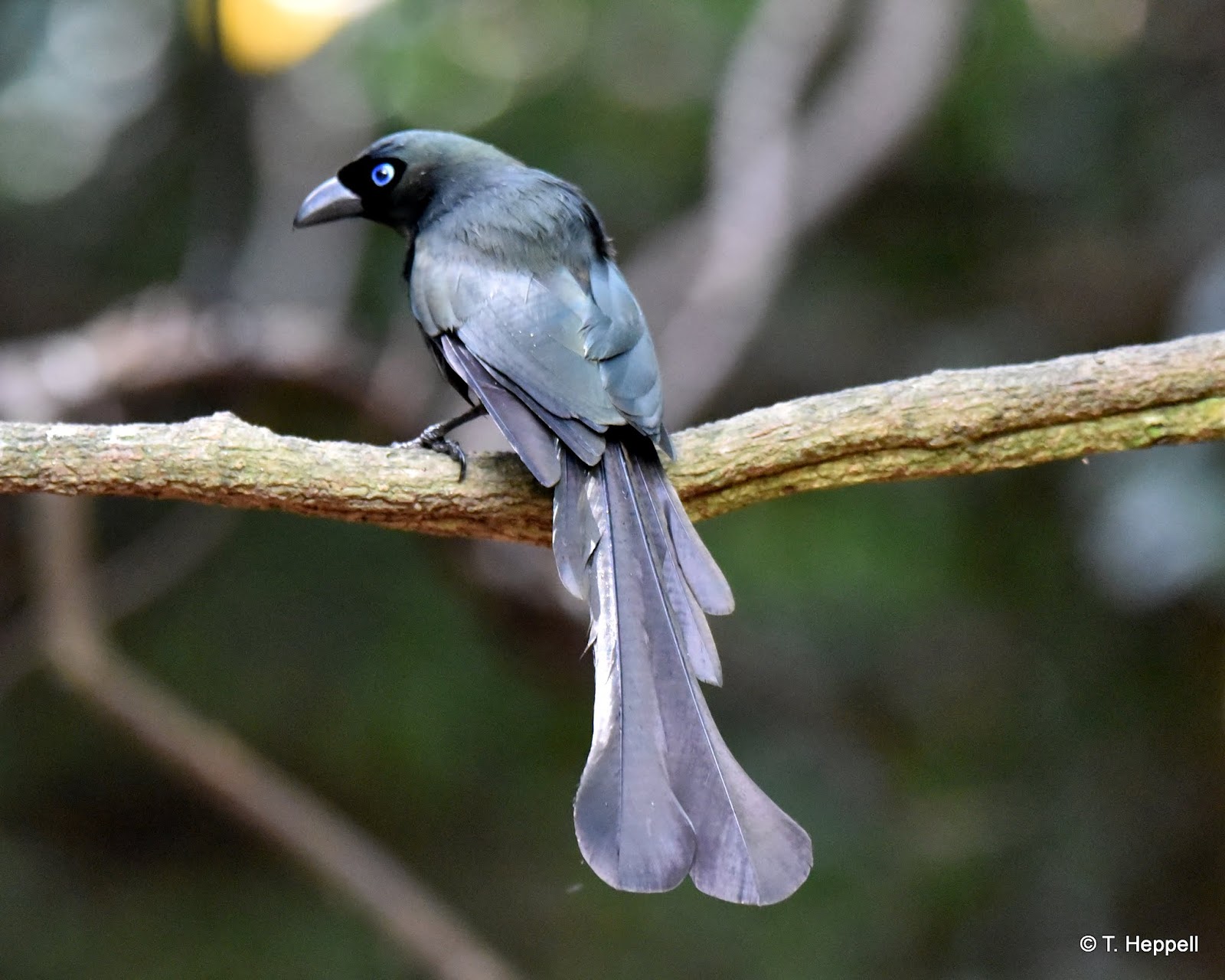
Racket-tailed Treepie


Bar-backed Partridge

Large Scimitar Babbler

Kalij Pheasant - F

Kalij Pheasant


 Laem Pak Bia & Pak Thale Photos                     Kaeng Krachan Photos

Birds Seen at Laem Pak Bia and Pak Thale:

1
Black-winged Kite
                      18
White-throated Kingfisher
2
Red-wattled Lapwing
19
Common Kingfisher
3
Asian Openbill Stork
20
Black-capped Kingfisher
4
Grey-headed Lapwing
21
Intermediate Egret
5
Asian Pied Starling
22
Little Egret
6
Red Turtle Dove
23
Chinese Egret
7
Blue-tailed Bee-eater
24
Great Egret
8
Crested Myna
25
Little Cormorant
9
Curlew Sandpiper
26
Grey Heron
10
Kentish Plover
27
Brown-headed Gull
11
Black-winged Stilt
28
Common Tern
12
Streak-eared Bulbul
29
Caspian Tern
13
Javan Pond Heron
30
Heuglin's Gull
14
Yellow-eyed Babbler
31
Painted Stork
15
Whiskered Tern
32
House Sparrow
16
Common Sandpiper
33
Brahminy Kite
17
Wood Sandpiper
34
Pied Fantail


  Birds Seen at Kaeng Krachan:

1
Oriental Magpie Robin
27
Blue-throated Barbet
2
Indian Roller
28
Great Barbet
3
Chestnut-headed Bee-eater
29
Golden-throated Barbet
4
Grey-cheeked Fulvetta
30
Pin-tailed Parrotfinch
5
White-rumped Shama
31
Hainan Blue Flycatcher
6
Black-naped Monarch
32
Ashy Drongo
7
Verditer Flycatcher
33
Crow-billed Drongo
8
Striped-throated Bulbul
34
Black-headed Bulbul
9
Flavescent Bulbul
35
Black-crested Bulbul
10
Racket-tailed Treepie
36
Sooty-headed Bulbul
11
Pin-striped Tit Babbler
37
Taiga Flycatcher
12
Scaly-breasted Partridge
38
Siberian Blue Robin
13
Bar-backed Partridge
39
Abbot's Babbler
14
Puff-throated Babbler
40
Arctic Warbler
15
Red Jungle Fowl
41
Vernal Hanging Parrot
16
Greater-necklaced Laughing Thrush
42
Blue-bearded Bee-eater
17
Green Magpie
43
Common Flameback
18
Tickell's Blue Flycatcher
44
Greater Flameback
19
Large Scimitar Babbler
45
Heart-spotted Kingfisher
20
White-browed Scimitar Babbler
46
Violet Cuckoo
21
Emerald Dove
47
Oriental Pied Hornbill
22
Kalij Pheasant
48
Thick-billed Flowerpecker
23
Red Legged Crake
49
Brown-throated Sunbird
24
Slaty-legged Crake
50
Coppersmith  Barbet
25
Grey-eyed Bulbul
51
Lineated Barbet
26
Mountain Bulbul
52
Black-thighed Falconet


Thursday, December 3, 2015


Day 1


Day 2


Day 3


Day 4


Day 5


Day 6


Day 7


Day 9


Day 10


Day 11


Day 12


Market near Gir80 apartment
Image2 text here Ïmage text here